
Kerberos probe
The Kerberos probe communicates directly with a Key Distribution Center (KDC) using a hand-rolled RFC 4120 implementation, with no GSSAPI or third-party Kerberos library. It supports three distinct operations: credential validation, AS-REP Roasting for offline cracking, and Kerberoasting for service account enumeration.
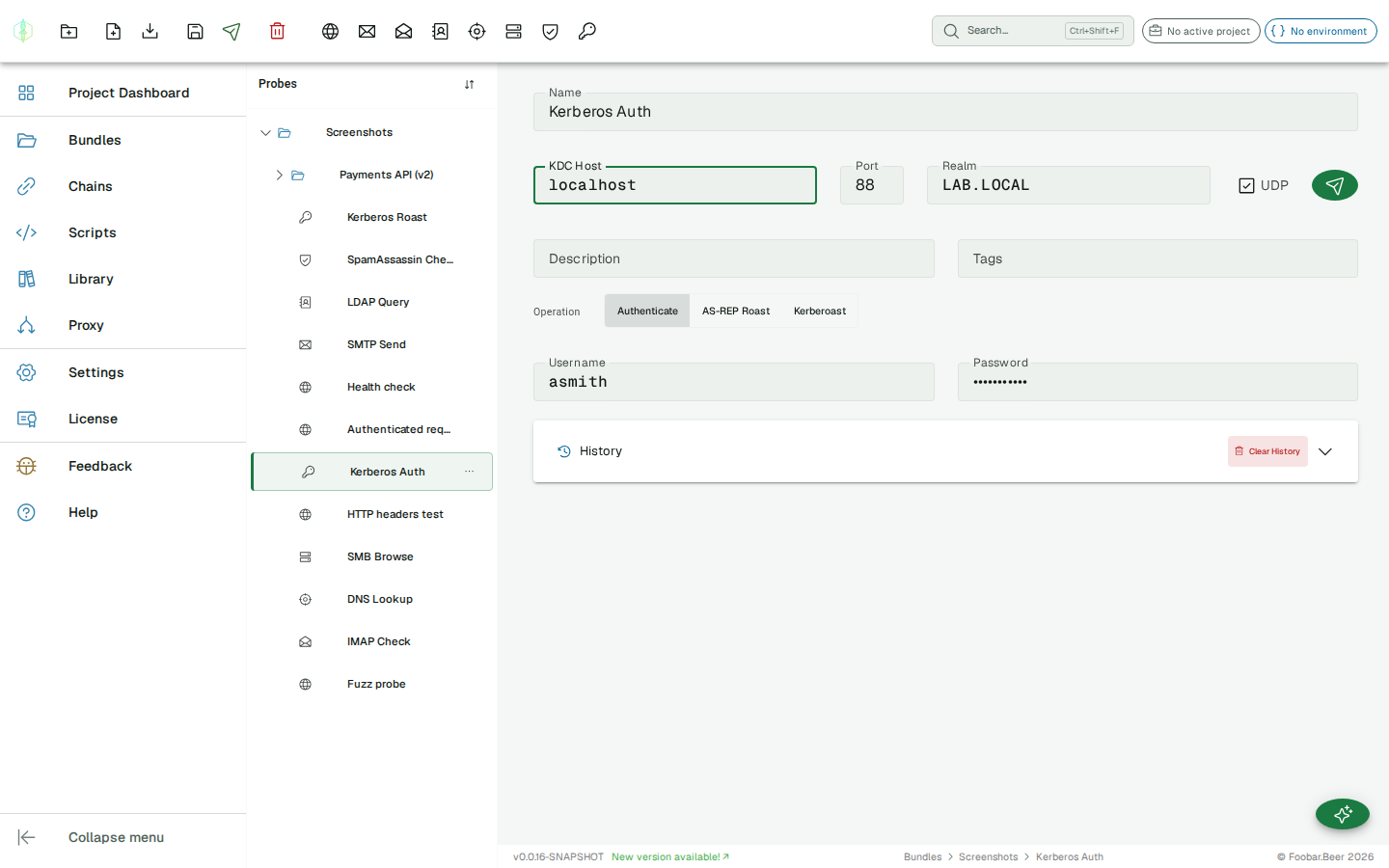
Connection settings
Section titled “Connection settings”| Field | Description |
|---|---|
| KDC Host | Hostname or IP of the Key Distribution Center |
| Port | KDC port (default: 88) |
| Realm | Kerberos realm in uppercase (e.g. LAB.LOCAL, CORP.EXAMPLE.COM) |
| UDP | Use UDP transport (default: on). The probe retries over TCP when the KDC answers KRB_ERR_RESPONSE_TOO_BIG, which is how a Windows KDC reports a reply too large for a datagram. Turn it off to use TCP throughout. |
Operations
Section titled “Operations”Choose the operation with the Operation toggle. Fields shown adapt to the selected mode.
Authenticate (AS_REQ)
Section titled “Authenticate (AS_REQ)”Validates a username and password by sending an AS-REQ with PA-ENC-TIMESTAMP pre-authentication. The timestamp is encrypted with the NT hash derived from the password using RC4-HMAC-MD5.
| Response | Meaning |
|---|---|
| OK | KDC returned AS-REP, so the credentials are valid |
| FAIL + KDC_ERR_PREAUTH_FAILED (24) | Wrong password |
| FAIL + KDC_ERR_C_PRINCIPAL_UNKNOWN (6) | Username does not exist |
| FAIL + KRB_AP_ERR_SKEW (37) | Clock skew too large (> 5 minutes) |
AS-REP Roast
Section titled “AS-REP Roast”Sends an AS-REQ without pre-authentication for the specified username. If the account has DONT_REQUIRE_PREAUTH set (common on service accounts), the KDC responds with an AS-REP whose encrypted part can be cracked offline.
No password is required, only the username.
The response includes the hash in hashcat format ready for mode 18200 ($krb5asrep$23$):
$krb5asrep$23$jdoe@LAB.LOCAL:a1b2c3...16hex...$rest...Copy the hash and run:
hashcat -m 18200 hash.txt wordlist.txtKerberoast
Section titled “Kerberoast”Authenticates with the provided credentials, obtains a TGT, then requests a service ticket for the specified SPN. The service ticket’s encrypted part is decryptable offline using the service account’s password hash.
| Field | Description |
|---|---|
| Username | Account with valid credentials to authenticate as |
| Password | Password for the authenticating account |
| SPN | Service Principal Name to request a ticket for (e.g. HTTP/web.lab.local, MSSQLSvc/db.lab.local:1433) |
The response includes the hash in hashcat format ready for mode 13100 ($krb5tgs$23$):
$krb5tgs$23$*svc_iis*LAB.LOCAL*HTTP/web.lab.local*$a1b2c3...16hex...$rest...Copy the hash and run:
hashcat -m 13100 hash.txt wordlist.txt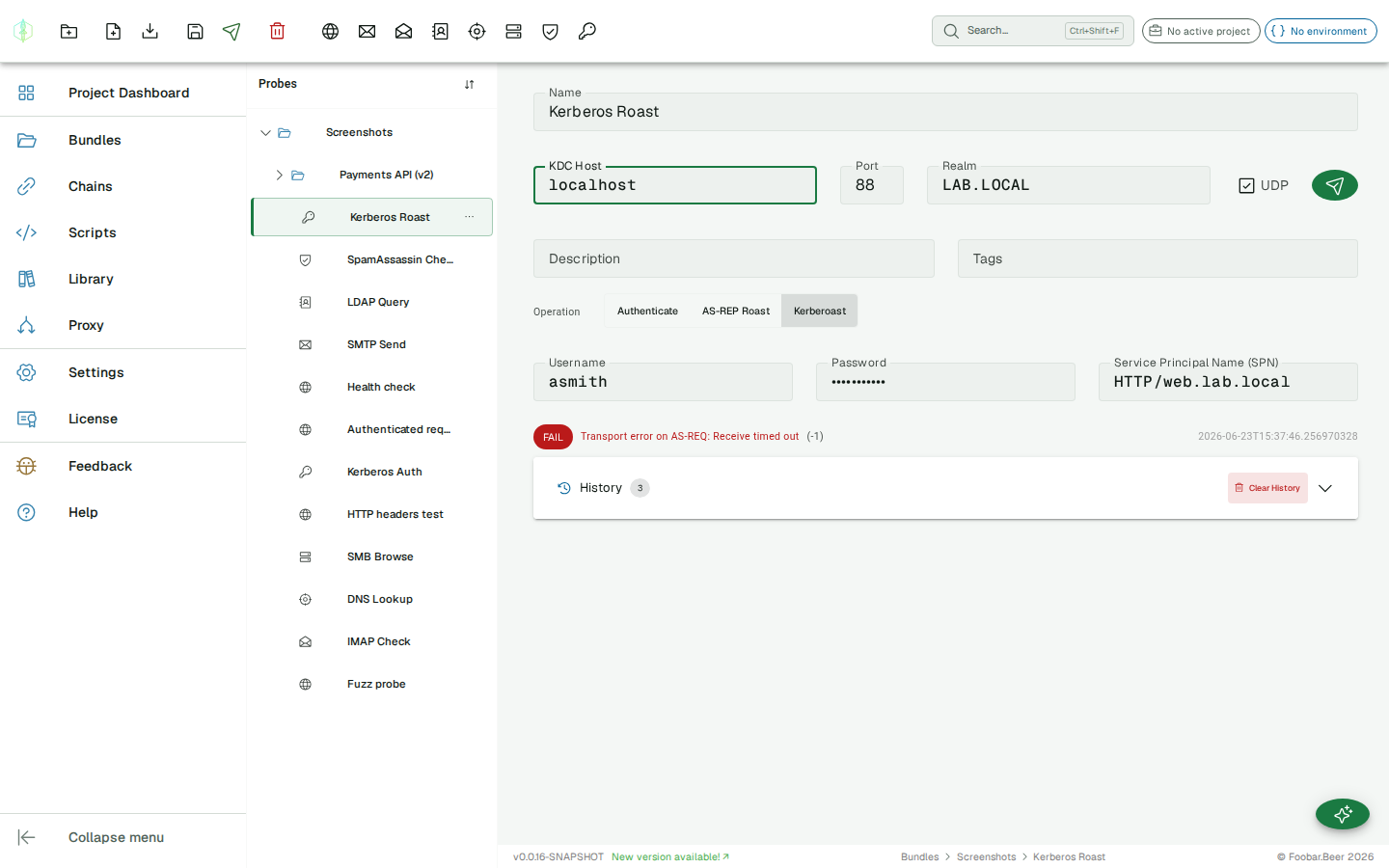
Response panel
Section titled “Response panel”Status bar
Section titled “Status bar”Shows OK or FAIL chip, the KDC error code and message if the request failed, and the encryption type reported by the KDC (e.g. etype 23 (RC4-HMAC)).
Hashcat hash card
Section titled “Hashcat hash card”For roasting operations, the hash is displayed in a copyable card with the appropriate hashcat mode label (-m 18200 or -m 13100). Click Copy to copy the full hash to the clipboard.
Exchanges
Section titled “Exchanges”The Exchanges panel lists each KDC message pair (AS-REQ / AS-REP, TGS-REQ / TGS-REP). Expand to inspect the raw hex of the request and response. Useful for verifying the exact bytes sent, since the probe writes raw DER-encoded Kerberos messages and does not normalize them through a library.
Variable substitution
Section titled “Variable substitution”{{variable}} placeholders are supported in host, realm, username, password, and SPN fields.
History
Section titled “History”The history panel shows the overall success/fail status and the realm/username for each past execution. Click any entry to restore the full response including the hashcat hash.
Implementation notes
Section titled “Implementation notes”The probe implements RFC 4120 (Kerberos V5) and RFC 4757 (RC4-HMAC-MD5 encryption) from scratch:
- ASN.1 DER: hand-rolled encoder and Cursor-based decoder; no external ASN.1 library
- RC4-HMAC-MD5: MD4 NT hash → K1/K2/K3 key derivation → RC4 stream cipher → HMAC-MD5 checksum
- Transport: UDP with automatic TCP fallback (4-byte length prefix per RFC 4120 §7.2.2)
- Encryption type 23 (
ETYPE_RC4_HMAC) is used for pre-authentication and ticket encryption, and it is the type cracked by hashcat modes 18200 and 13100